

Venturi Effect: The Super Mask has structured the internal architecture of the respirator with a specific geometric constriction; incoming and outgoing filtered air can be accelerated.
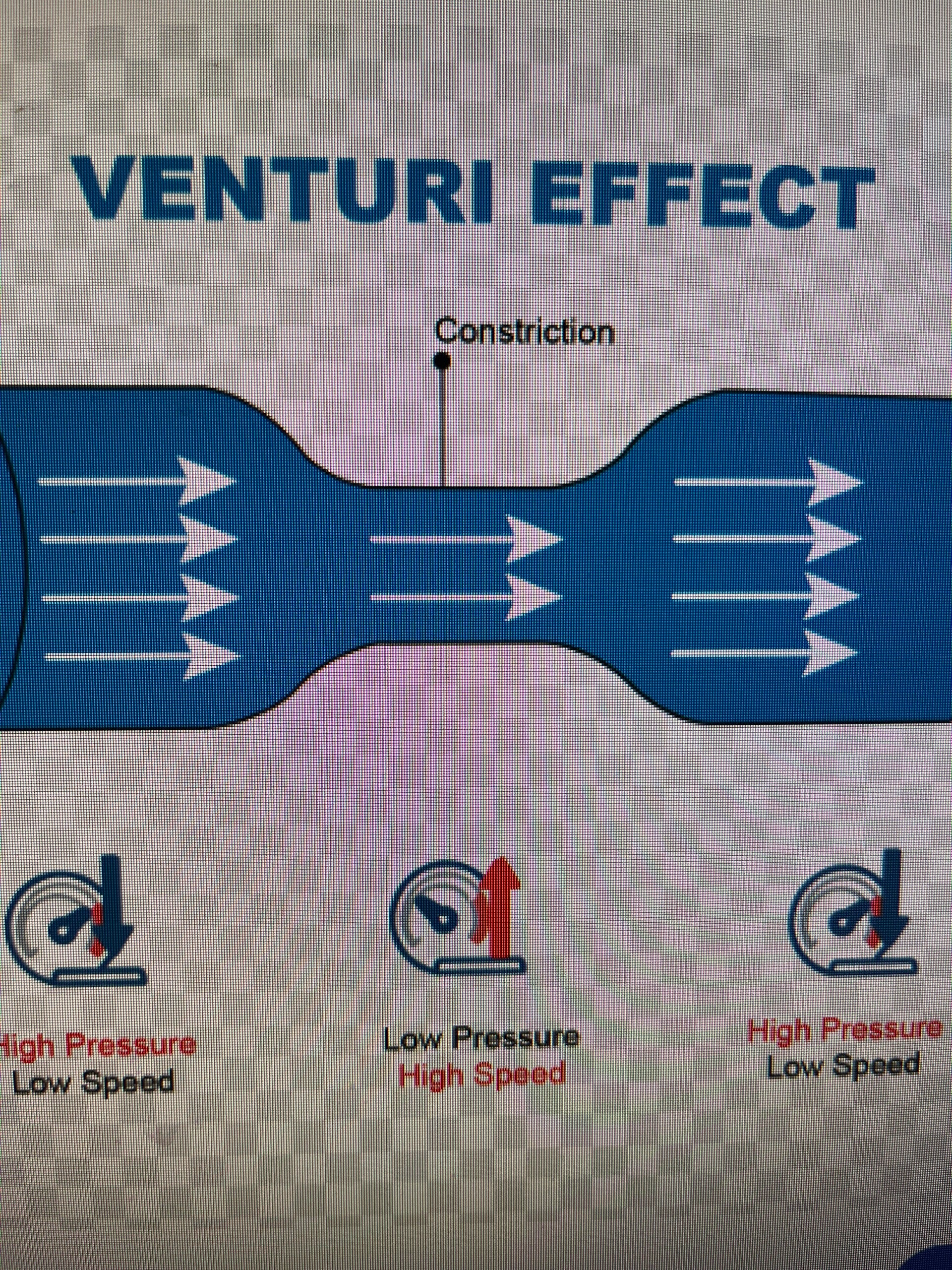
According to Bernoulli’s Principle, as the velocity of this incoming air increases through a narrow channel, its local static pressure drops.
This pressure drop pulls the flexible perimeter of the silicone seals of the mask inward, tighter against the user's skin. The force of the inhalation itself is converted into an aerodynamic mechanism that seals the mask’s gaps mechanically.
During exhalation, a respirator must flush out carbon dioxide (CO2) and moisture as quickly as possible without adding breathing resistance.
Jet Mixing and Entrainment: When the user exhales, air will be forced through the designed geometric narrowing. This creates a high-velocity "jet" of exhaled breath.
Venturi Sweeping: This fast-moving exhalation stream creates a localized low-pressure drop behind it. It acts as a fluid pump, actively pulling the remaining stagnant air and moisture pockets out of the mask's "dead space." This lowers the overall work of breathing and optimizes comfort.
Venturi Sweeping
How It Works
- Narrow space: A fluid (like air) flows into a smaller or tighter area.
- Faster speed: The air must speed up to keep the same amount of flow moving through the smaller space (mass continuity).
- Lower pressure: As the speed goes up, the internal pressure (static pressure) goes down (conservation of energy/Bernoulli's principle).
- Suction: The lower pressure inside the narrow part creates a vacuum effect that can pull in air.