

The Danger of Gaps
Location of the Leaks: When an N95 does leak, computational fluid dynamics (CFD) models show that 40% of the leakage occurs around the nose bridge, while 26% occurs on each cheek/side. Impact of Movement & Time: Even if an N95 seals perfectly when you first put it on, real-world movement shifts the mask. A study tracking healthcare workers found that 13% of masks leaked after just 1 hour of active work, and a cumulative 65% failed to maintain a seal after 4 hours of continuous wear.
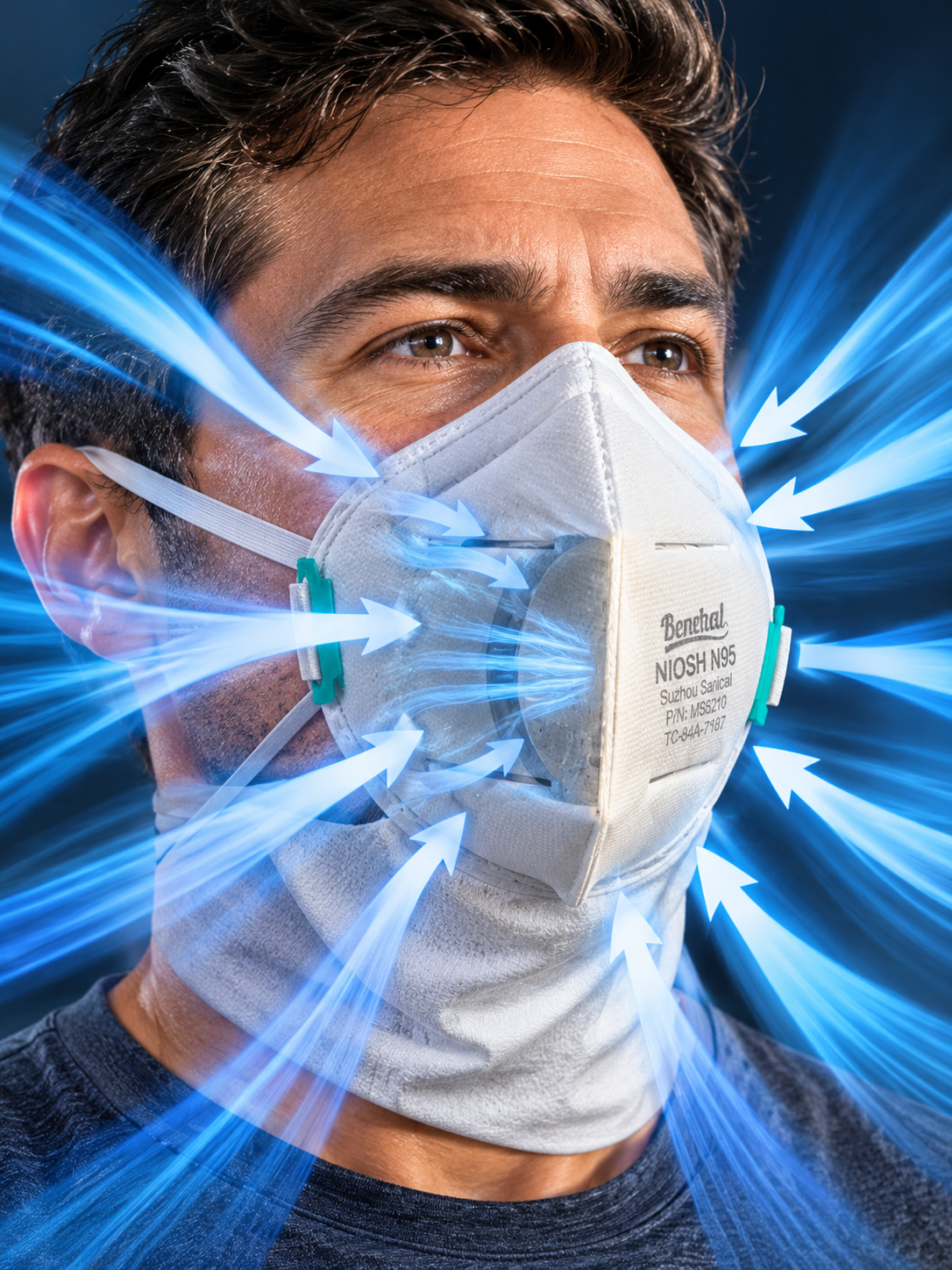
Airflow problems
Airflow enters a properly sealed N95 respirator mask by being pulled directly through the multi-layered filter material of the mask itself when you breathe in.
How Inhalation Works
Filter Media: Air is drawn through the entire surface area of the dense mesh of synthetic fibers.
The Danger of Gaps
Air naturally follows the path of least resistance. If there is a gap along the edge of the mask, air will bypass the filter entirely and rush through that opening, drawing in unfiltered particles and drastically reducing your protection.
Studies show that N95 mask fit failure and leakage increase progressively over time with extended use, with 12.5% of wearers failing a fit test after 1 hour and 65% failing by 4 hours.
Timeline of N95 Leakage and Fit Failure
- At 1 Hour: A prospective cohort study on healthcare workers found that 12.5% of participants experienced a fit-test failure, indicating increased leakage. [1]
- At 2 Hours: Filtration efficiency can significantly decrease under deep breathing conditions due to increased humidity and moisture buildup. [
- At 4 Hours: Fit failure rates rise sharply, with 65% of study participants showing seal or leakage compromise during normal duties. [1]
- Up to 8 Hours: While N95 respirators can maintain stable material efficiency for up to 8 hours under ideal or light conditions, facial movement, jaw motion, and sweat gradually degrade the physical seal.